Commerce Meets Intelligence: Agentic Commerce and the Golden Catalog
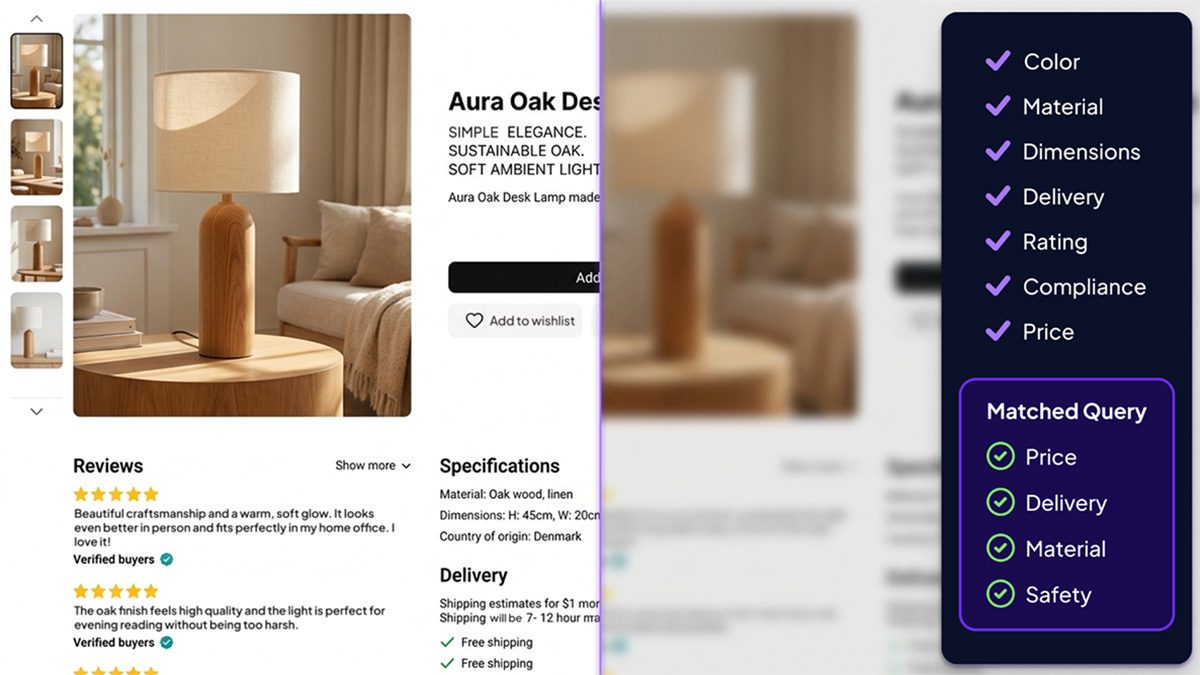
The way people find and buy products is going through a fundamental shift. It is not only how people buy that is changing, it is who, or what, is doing the buying. We are moving from an internet built for humans to one increasingly read by AI agents. Welcome to agentic commerce, where AI agents, not browsers, drive more and more of the transaction.
The shift: from human-centric to agent-centric commerce
For decades, eCommerce revolved around people: rich descriptions, lifestyle images, curated filters. Tomorrow’s shoppers will not all be people. Many will be AI agents acting on their behalf.
These agents do not scroll. They compute.
Instead of reading a product description like: “A cozy fall cardigan in rich burgundy…”
they read structured data like:
- Color: Burgundy
- Delivery: 2 days
- Rating: 4.7
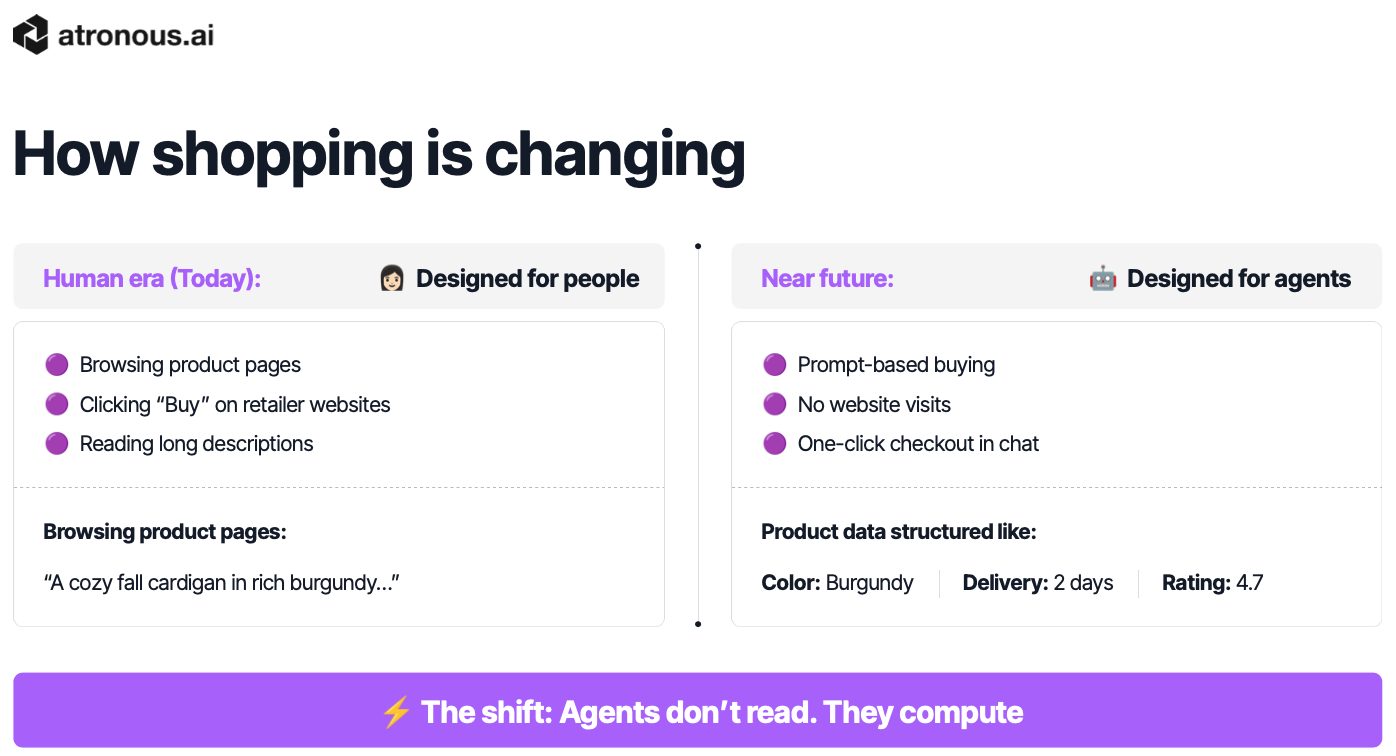
Voice prompts, zero-click checkout, and agents that compare options on a shopper’s behalf are reshaping how products are discovered, compared, and bought. This is not science fiction. It is happening now, led by assistants like ChatGPT, Gemini, and Claude, and it runs on agent-ready product data.
What agentic commerce demands
When an AI agent does the shopping, the rules change:
- Agents need structured, machine-readable data.
- Subjective or unstructured product pages get ignored.
- What matters is how computable, and how trustworthy, your product data is.
An agent cannot choose what it cannot read, and it will not trust a value it cannot verify.
Where atronous fits in: the authoritative source agents read
At atronous, we make your product data the authoritative source that AI agents read and trust. We call the result a Golden Catalog: one normalized, validated, agent-ready attribute set that represents your products correctly everywhere they appear.
What that looks like
- Agent-readiness scoring: See how well your current listings perform for AI agents, and exactly which attributes are missing for AI agent discovery.
- Attribute generation and validation: Generate the structured attributes agents need, such as variants, dimensions, delivery, and compliance fields, and validate every one against category-specific rules before delivery.
- Missing-field detection: Find and fill the gaps an agent needs in order to choose your product.
- Agent-ready delivery: Deliver validated data to your channels and to the AI agents that read them, so your products show up correctly when shoppers and their agents compare options.
In short, we make your products readable, comparable, and trustworthy to a machine.
Why this matters
In agentic commerce, visibility depends on structure. If an agent cannot interpret your product, it will not be shown, compared, or recommended.
Imagine a shopper telling their assistant, “Find me a non-toxic kids’ chair under $100 that ships in two days.” The agent filters millions of options on those exact attributes. If your product is missing a safety or delivery value, it is not ranked lower. It is out of the set.
This is the next discipline after SEO. As agents take over discovery, structuring your attributes so they can be read, compared, and recommended has a name: AEO, or Agent Engine Optimization. It is where being chosen by a machine is won.
The future is agentic. Are you ready?
We are entering a world where agents shop alongside people. Winning in it takes new playbooks, new catalogs, and product data built to be read by machines.
That is what atronous is built for: to make your brand show up, get compared, and get chosen, whether the buyer is a person or an AI agent.