UPC Check Digits: What They Catch, and What They Miss
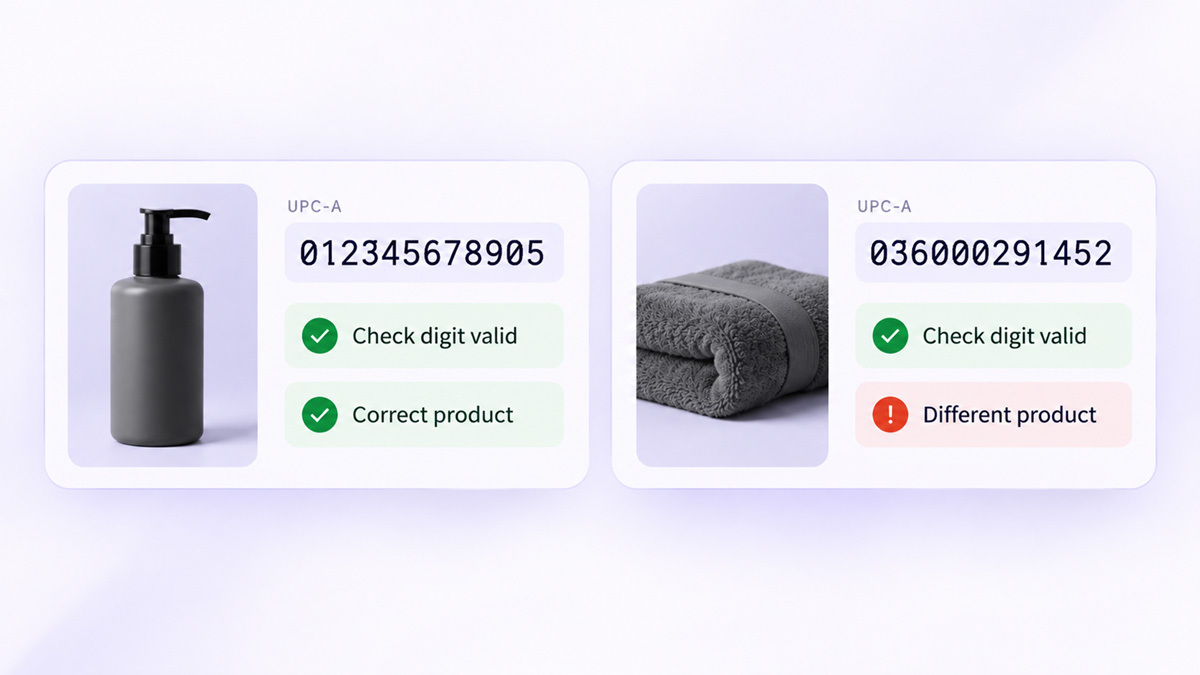
A UPC check digit is a transcription checksum designed for an era of manual keying. It exists to answer one question: was this number typed correctly? It does that well. But most catalogs assume a passing check digit means the number actually belongs to the product. It does not.
A catalog can boast a 100% check-digit pass rate while still carrying duplicates, identifiers registered to other companies, vendor-invented codes, or case codes assigned to single units. Every one of these passes the math. Any one of them can cause rejection, suppression, or incorrect merging at a marketplace.
Check digits test a single cell. Real identifier failures are relational. Here is what your check digit misses, what real validation requires, and why relying on basic math is costing you visibility.
The failures a check digit cannot see
The most expensive data problems involve numbers that are perfectly intact and mathematically valid, but contextually wrong. No single-record checksum can detect these errors.
Valid identifiers on the wrong product. A simple copy-paste error or a shifted spreadsheet row attaches a perfect code to the wrong record. The number passes every test because the number itself is fine. It just describes something else.
Catalog duplicates. The same identifier assigned to two separate records cannot be detected by per-record validation. Marketplaces do compare records, and they respond by rejecting the listings, suppressing both, or merging them incorrectly.
Invented codes. Generating a twelve-digit number with a correct check digit takes seconds. Vendors pressured to supply an identifier sometimes just invent one. Passing the algorithm is not evidence of GS1 registration.
Unlicensed prefixes. Codes bought from third-party resellers carry someone else’s company prefix. The code still passes the checksum, because the checksum cannot tell who licensed the prefix. Marketplaces that verify licensing against the issuing registry will reject the product.
The wrong packaging level. A GTIN-14 with a non-zero indicator digit often identifies a case rather than a consumer unit. Put a case code on a single-unit item record, and the arithmetic passes while the listing misrepresents what the customer is buying.
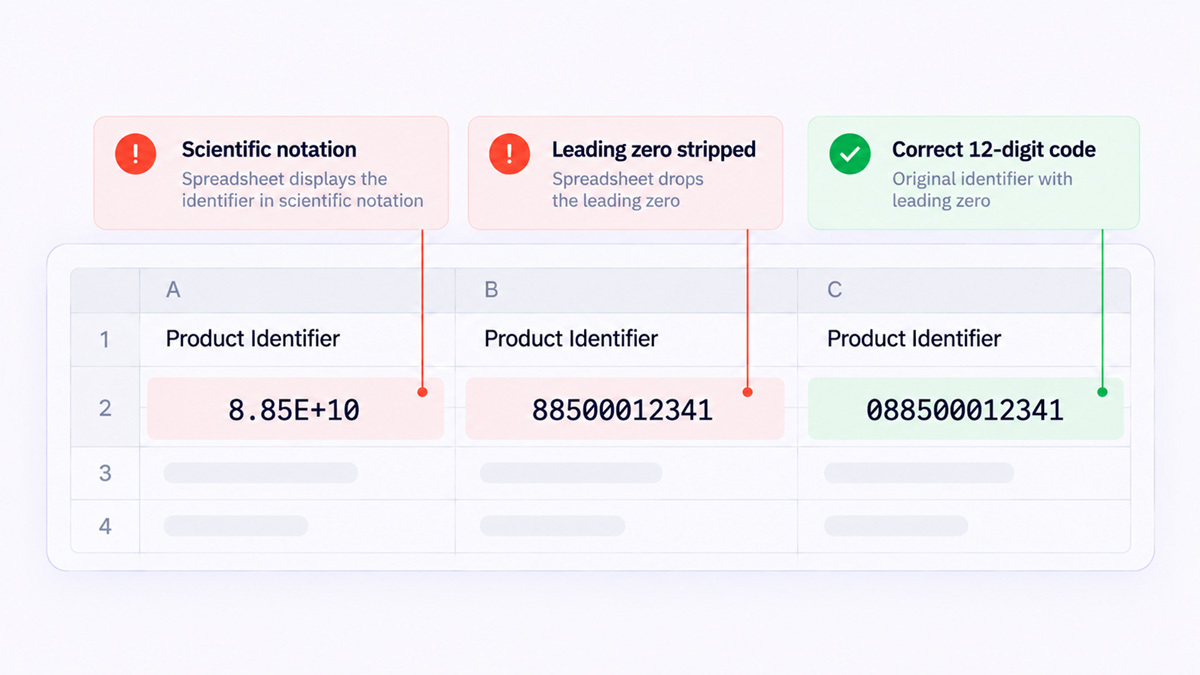
Spreadsheet corruption. Open a product file in a spreadsheet, and twelve-digit identifiers are often read as numbers. Leading zeros can disappear, turning a valid code into a different, invalid one, and nothing on screen shows that it happened.
What real validation looks like
Identifier validation that reflects real risk requires more than arithmetic. It must confirm the identifier is unique across the entire delivery, not just mathematically consistent within its own row.
True validation cross-references the identifier against the issuing registry to confirm the prefix belongs to the licensee claiming it. It correlates the identifier with the manufacturer part number and the surrounding attributes on the record. If an identifier disagrees with every other field on the page, the check digit’s approval does not matter.
At atronous, identifiers pass through multiple checks covering format, check digit, registry cross-reference, uniqueness across the delivery, and manufacturer part number correlation before anything is delivered. A record that fails is flagged with its reason, not silently dropped. Which checks matter most varies by category. The rules governing industrial distribution are not the rules governing grocery.
What our 100% metric actually means
Atronous reports a 100% UPC and EAN check-digit pass rate with zero duplicate identifiers on enterprise delivery runs. We can state this absolutely because both tests are deterministic: a code either satisfies the algorithm or it does not, and a set of codes either contains a duplicate or it does not.
However, a check-digit pass rate is not an accuracy figure. It proves conformity and uniqueness within the delivered dataset. It does not prove every code maps to the correct product. A vendor who tells you their basic validation catches identifier errors is telling you a very narrow truth. Ask them which errors.
Why this is getting more expensive
Identifier errors used to just cause annoying rework when a human rejected a listing. Today, product records are consumed by automated matching, search, and AI systems.
A duplicate identifier silently merges two distinct products. A missing or unresolvable identifier leaves a product out of the comparison entirely. There is no error message, just lost visibility and lost sales. Validity alone is no longer sufficient; identifier work is a mandatory part of data refinement, not a formatting step on the way out the door.
For the technically curious: how the math fails
For those interested in why the algorithm misses certain typos, it comes down to alternating weights.
To calculate a GTIN-12 check digit, the preceding eleven digits are alternately multiplied by three or one, summed, and subtracted from the nearest equal or higher multiple of ten. GS1 publishes the full method. The weighting guarantees every single-digit typo is caught.
However, it misses specific swapped numbers. Because of the alternating multiplier, swapping two neighboring digits changes the total sum by exactly twice the difference between them. If that difference is exactly five (for example, typing 61 instead of 16, or 05 instead of 50), the sum shifts by exactly ten, so the check digit comes out the same. The error passes. Ten out of the ninety possible digit pairs transpose undetected by the algorithm.
See your own identifiers checked
The fastest way to uncover what is hiding in your catalog is to test a sample. Send up to 50 SKUs out of your PIM or ERP to the atronous Data Quality Assessment exactly as they live in your system. We will run them through the same pipeline our enterprise customers rely on.
Within five business days, you receive the validated sample back alongside taxonomy recommendations, measured against the rules of their actual categories.
No pitch. Just your own records. Request your Data Quality Assessment, or see how atronous handles technical and industrial product data.
Intelligence in every attribute.
Frequently asked questions
What is a check digit on a UPC?
It is the final digit of a twelve-digit GTIN-12, the number printed under a UPC-A barcode. It is calculated from the eleven digits before it: multiply them alternately by three and one, add the results, and subtract the total from the nearest equal or higher multiple of ten. Its sole purpose is to catch manual typing or scanning errors.
Does a valid check digit mean a UPC is correct?
No. It only means the number is mathematically consistent. It does not guarantee the identifier is registered, licensed to your company, or attached to the correct product. A code with a valid check digit can still be a duplicate, sit on the wrong item, or identify a case rather than a single unit.
What errors does a UPC check digit fail to catch?
It misses all relational errors: duplicates, recycled identifiers, invented codes, unlicensed company prefixes, and codes attached to the wrong product. Mathematically, it also misses a swap of two neighboring digits when those digits differ by exactly five, such as 2 and 7, or 4 and 9.
Why do UPCs get corrupted in spreadsheets?
Spreadsheets often treat product identifiers as numbers rather than text. When that happens, leading zeros can be stripped, which turns a valid code into a different, invalid one. Long identifiers may also display in scientific notation, and depending on how the file is edited and saved, the exact value may not survive. Storing identifiers as text, or padding them to the fixed 14-digit format GS1 recommends for databases, prevents this damage.